| TUESDAY, 19 OCTOBER 2004 - FATHER AND SON | ||
| previous post | ||
|
"EMT, TOC." Here we go again. "Three litter patients,
two with gunshot wounds to the legs, one with massive chest trauma,
all urgent surgical." Although we still never know exactly
what to expect, some information is better than none. One time
we were notified of an incoming open pelvis fracture and it turned
out to be a stubbed toe. At any rate, we prepared for three
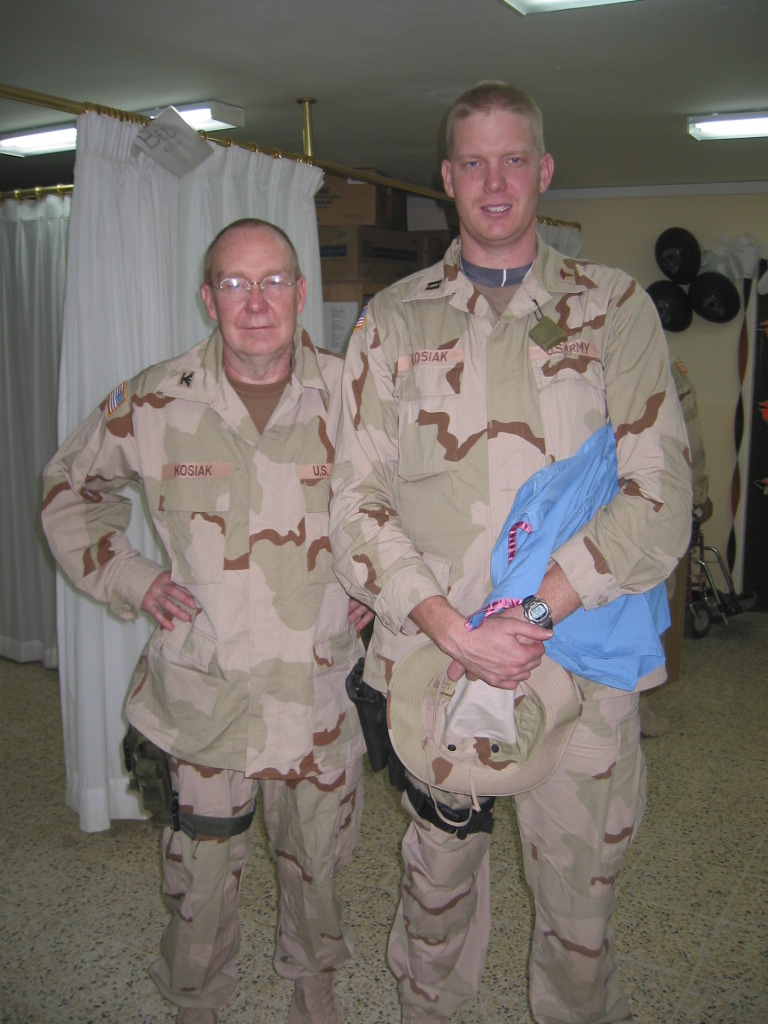
seriously injured patients. That is what we got. The patients turned out to be civilian contractors that work for this company called Global Security. This company provides security for civilian convoys all throughout Iraq. They are out on the roads a lot and frequently get shot at or ambushed with IED's. This time it was both. The first patient had a gunshot (or shrapnel - hard to tell the difference sometimes) wound to his right upper chest. He was already intubated and a chest tube was in place. Well actually it was in the wrong place, but we quickly fixed that. It was quickly noted that he did not have a pulse in his right wrist. Clearly there was some type of vascular (i.e. blood vessel) injury. He was going to need surgery fast. We did some other stabilizing measures and then off to surgery he went. The second patient had a severely fractured right femur (the big bone in the upper part of your leg). The bone was grossly angulated and there was a large amount of swelling in the area of the fracture, obviously from blood. Femur fractures can bleed a lot, but given that amount of swelling and the severity of the femur fracture, we suspected another vascular injury. Someone out in the field (I still have not been able to find out who it is to commend this person) put an excellent tourniquet on this guy, effectively saving his life. Without that tourniquet this guy would have easily bled to death in minutes. He too was quickly off to surgery. Two patients in surgery at the same time is a bit of a stress to our system, but we had no choice at that time, it had to be done. The third patient had through and through wounds to both his calves with broken bones in both his legs. His injuries were less serious than the others. He was stabilized and set to go to surgery after the other two were through. The first patient turned out to have a major injury to his axillary artery (the major artery that supplies pretty much the entire arm). Our surgeons were able to use a piece of vein from another part of his body and reconnect the two damaged ends. He did quite well after that. The second patient was a bit more challenging. He had lost a lot of blood and was still bleeding. He did in fact have an injury to both the femoral artery and vein (the major artery and vein in the thigh). In addition he had a major fracture of the femur with significant amounts of bone missing. He had a major soft tissue injury in the area as well, with significant damage to and loss of muscle. All of these injuries resulted in A LOT of bleeding. I mean A LOT. In response to this massive bleeding, he received a massive resuscitation. This included 23 liters of iv fluids, 12 units of red blood cells, 8 units of whole blood (obtained from a blood drive utilizing our CSH personnel and a couple of Special Forces soldiers), 4 units of plasma, and a couple doses of albumin. Well, that is a lot of IV fluids. When you give someone IV fluids, only about 1/3 of it stays in the blood vessels, the other 2/3 spills into other tissues in the body. So, it wasn't long before his belly became very hard. His abdomen and bowels had essentially filled up with water. Because the abdomen is a closed space, the pressure increases and impedes the blood flow to the bowel; this is called abdominal compartment syndrome. So, at the bedside in the ICU, the surgeons opened up his abdomen, drained a lot of fluid out, and left the abdomen open so the bowels could expand more. Next, it was noted that the calf on the side of the injury was very hard. The combination of the IV fluid, the injury, and the damaged vein was causing a lot of swelling in the lower part of the leg. This is another closed space, and if pressure builds up too much muscle and nerve damage can occur; this is called lower extremity compartment syndrome. So, next the surgeons made large incisions in his leg (called a fasciotomy) to allow for ample room for the muscles to swell. If that wasn't enough, several hours later his blood pressure markedly increased, and his heart rate dropped. A sign of neurologic problems. CT scan of his head revealed mild swelling of the brain - all that iv fluid was being spread ALL over his body. He was given mannitol and lasix (diuretics - medicines that help people urinate off excess fluid) and he responded quickly and adequately. He finally started to stabilize. Sometimes it is scary how three patients can stress the system so much... On another note, some new reservist docs arrived today. Two of them were coming to work with the 118th ASMB, a support unit that helps us with our sick-call and ambulances. These two docs were a father and son team! I thought that was quite impressive. COL and CPT Kosiak. COL Kosiak is a Family Practice doc from RURAL North Dakota, he will be working here at the CSH. CPT Kosiak is an ER doc from the Mayo Clinic who will be working at Camp Freedom (an FOB down the road). I am sure this is quite historical, a father and son physician team in a combat zone together. They said they both came together so their wife/mother would only have to worry for 3 months, instead of 6 months. We are happy to have them, they will be a wonderful addition to our CSH team.
|
||
|
COL Kosiak and CPT Kosiak |
||